Lecture 21 THE MEASUREMENT OF CUTTING TEMPERATURES
L 21.1 THE MEASUREMENT OF CUTTING TEMPERATURES
A number of methods have been developed for the measurements of temperatures in metal cutting. Some of these methods only make it possible for the average cutting temperatures to be determined, but effective methods are available for determining temperature distributions in the workpiece, chip, and tool near the cutting edge.
A. WORK-TOOL THERMOCOUPLE
A technique widely used to study cutting temperatures is the work-tool thermocouple technique. In this technique the electromotive force (emf) generated at the junction between the workpiece and tool is taken as a measure of the temperatures in this region. A typical work-tool thermocouple arrangement on a lathe is shown in Figure 18.4. It is important when using this technique to insulate the thermocouple circuit from the machine and to use the same circuit when calibrating the thermocouple. It may be assumed that the reading given by this method is an indication of the mean temperature along the chip-tool interface. This technique has been used extensively in the past to investigate the effects of changes in cutting conditions on cutting temperatures and to obtain empirical relationships between temperature and cutting-tool wear rate. However, the work-tool thermocouple method is limited because it gives no indication of the distribution of temperature along the tool rake face.
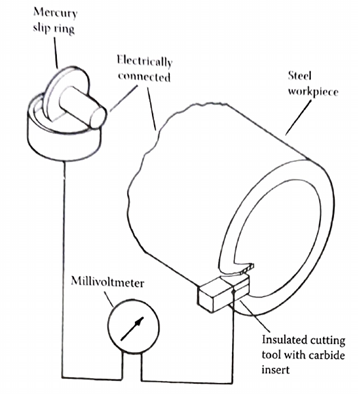
Fig. 18.4 Work-tool thermocouple circuit
There are a number of sources of error in using the work-tool thermocouple. In particular, the tool and work materials are not ideal elements for a thermocouple. Consequently, the emf tends to be low and the emf/temperature calibration nonlinear. The work-tool thermocouple must be calibrated against a standard thermocouple. Each tool and workpiece material combination must be calibrated separately. In addition, it is unlikely that the emf determined with a stationary tool, used for calibration, is the same as that obtained for an equivalent temperature during cutting when the work material is being severely strained.
B. DIRECT THERMOCOUPLE MEASUREMENTS
Direct thermocouple measurements can be made during cutting. In these experiments, the rig was first run without cutting, and the reading on the milli-voltmeter resulting from the rubbing action of the constantan wire on the workpiece was noted.
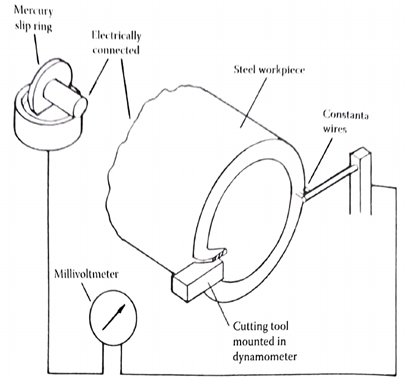
Fig.18.5 Arrangement for
measurement of workpiece temperature s using the thermocouple
technique.
This reading was subsequently subtracted from the readings taken while cutting was in progress. With this method, the temperatures at selected points around the end face of the tubular workpiece were measured and then used to calculate the proportion of the shear-zone heat conducted into the workpiece. Direct measurement of temperatures can be made by making a hole in the tool close to the cutting edge and inserting a thermocouple to measure the temperature at a particular position. This can then be repeated with holes in various positions to give an estimate of the temperature distributions. Significant errors may occur where the temperature gradients are steep, as the holes for the thermocouples may cover a considerable range of temperature. In addition, the presence of the holes may distort the heat flow and temperature fields in the tool.
C. RADIATION METHODS
When the tool-workpiece the area can be observed directly, cameras and film sensitive to infrared radiation can be used to determine temperature distributions. The result is obtained from an infrared photograph of the cutting operation. In the technique used to produce this result a furnace of known temperature distribution was photographed simultaneously with the cutting operation using an infrared-sensitive plate, enabling the optical density of the plate to be calibrated against temperature.
For the result shown in Figure 18.2 the workpiece was preheated because of the relatively low the sensitivity of the infrared photographic plates available at that time. Improvements in infrared-sensitive films and development of thermal imaging video cameras now make it possible to determine temperature distributions for workpieces at room temperature. Modern miniature electronic photodetectors arranged in a focal plane array system enable temperature distributions to be determined with resolutions as low as 5 μm.
D. HARDNESS AND MICROSTRUCTURE CHANGES IN STEEL TOOLS
The room-temperature hardness of hardened steel decreases after reheating, and the loss of hardness is related to the temperature and time of heating. The hardness decreases in the result of changes in the microstructure or the steel. These structural changes can be observed using optical and electron microscopes. These changes provide an effective means of determining temperature distributions in the tool during cutting. Microhardness measurements on tools after cutting can be used to determine constant- temperature contours in the tool, but the technique is time-consuming and requires very accurate hardness measurements.
The structural changes in the material take place gradually, but it has been observed that for some high-speed steels distinct modifications occur at approximately 50°C intervals between 600 and 900°C. This permits temperature measurements with an accuracy of ±25°C within the heat-affected region. Metallographic examination of the tool after cutting makes it possible for temperature distributions in the tool to be determined, but requires experienced interpretation of the observed structural changes. This method has been used to study temperature distributions in high-speed steel lathe tools and drills. The main limitation of this method of temperature estimation is that it can be used only within the range of cutting conditions suitable for high-speed steel and when relatively high temperatures are generated.