- Teacher: Alok Sharma
Mechanical Engineering Department (MAIT)
Skip available courses


Available courses
Course Outcmoes
1. Demonstrate the working procedure and mechanism of machine tools
2. Design and analyze the geometry of a single point cutting tool
3. Enhance the skill and knowledge by creating components using machine tools
4. Utilizing advance machining process and technique to predict the performance of machine tools
1. Demonstrate the working procedure and mechanism of machine tools
2. Design and analyze the geometry of a single point cutting tool
3. Enhance the skill and knowledge by creating components using machine tools
4. Utilizing advance machining process and technique to predict the performance of machine tools
- Teacher: Vipin Kumar Sharma
Course Objectives :
1. To understand ab-initio design concepts under various constraints, stress concentration and dynamic loading. Also analyse the design of static joints and pipes.
2. To conceptualise joints for power transmission in rotating parts, suspension parts and in leverage.
3. To analyse bolted & screwed fastenings and structural plates joining for complex engineering applications under myriad of loads.
4. To thoroughly understand the design procedure for speed variation effects in toothed elements and power screws.
1. To understand ab-initio design concepts under various constraints, stress concentration and dynamic loading. Also analyse the design of static joints and pipes.
2. To conceptualise joints for power transmission in rotating parts, suspension parts and in leverage.
3. To analyse bolted & screwed fastenings and structural plates joining for complex engineering applications under myriad of loads.
4. To thoroughly understand the design procedure for speed variation effects in toothed elements and power screws.
- Teacher: Sumit Joshi
Course Objectives :
1. To understand the working of steam nozzle at design condition and off design condition. To
differentiate clearly between impulse and impulse-reaction turbine.
2. To understand the working of reciprocating compressor & refrigeration cycle.
3. To understand the combustion in I.C engine and appreciate the concept of knocking.
4. To be able to compute performance parameters of an I.C engine and to determine components of heat balance of given i.C engine.
1. To understand the working of steam nozzle at design condition and off design condition. To
differentiate clearly between impulse and impulse-reaction turbine.
2. To understand the working of reciprocating compressor & refrigeration cycle.
3. To understand the combustion in I.C engine and appreciate the concept of knocking.
4. To be able to compute performance parameters of an I.C engine and to determine components of heat balance of given i.C engine.
- Teacher: Deshdeep Gambhir
Course Objectives :
1. To develop the knowledge of lattice structure and their defects.
2. To develop the relation between structural and mechanical properties of metals for the selection of product design.
3. Identify the microstructure and properties of Iron-Iron carbide Phase diagram.
4. To develop the knowledge of various composite materials and their applications.
Course Outcomes (CO):
After completion of the course, the student will be able to
1. Summarize the properties of crystal structures of metallic elements and understand the mechanism of diffusion and deformation.
2. Relate the material behaviour under environmental conditions and interpret the characteristics of steel through iron- iron carbide and TTT diagram.
3. Relate the properties of steel with heat treatment processes and study the effect of alloying elements in steel.
4. Classify types of corrosion and composites.
1. To develop the knowledge of lattice structure and their defects.
2. To develop the relation between structural and mechanical properties of metals for the selection of product design.
3. Identify the microstructure and properties of Iron-Iron carbide Phase diagram.
4. To develop the knowledge of various composite materials and their applications.
Course Outcomes (CO):
After completion of the course, the student will be able to
1. Summarize the properties of crystal structures of metallic elements and understand the mechanism of diffusion and deformation.
2. Relate the material behaviour under environmental conditions and interpret the characteristics of steel through iron- iron carbide and TTT diagram.
3. Relate the properties of steel with heat treatment processes and study the effect of alloying elements in steel.
4. Classify types of corrosion and composites.
- Teacher: Naveen Solanki
Course Objectives :
1. To understand the concepts of metal cutting and tool materials.
2. To develop an understanding of the various machine tools.
3. To introduce students to different gear forming methods and jigs & fixtures
4. To acquire a fundamental knowledge on non-traditional machining processes.
1. To understand the concepts of metal cutting and tool materials.
2. To develop an understanding of the various machine tools.
3. To introduce students to different gear forming methods and jigs & fixtures
4. To acquire a fundamental knowledge on non-traditional machining processes.
- Teacher: Vipin Kumar Sharma
Lab Overview
In AI, it is important to map logical statements to real-world entities, making the system capable of reasoning and decision-making. Students will study how to use facts, rules, and queries to build intelligent systems that can reason and make inferences. For that, they learn to write programs on Prolog (Programming in Logic) which is a declarative language widely used for AI applications. In the lab, students also implement search algorithms like breadth-first search, depth-first search for pathfinding problems.
In AI, it is important to map logical statements to real-world entities, making the system capable of reasoning and decision-making. Students will study how to use facts, rules, and queries to build intelligent systems that can reason and make inferences. For that, they learn to write programs on Prolog (Programming in Logic) which is a declarative language widely used for AI applications. In the lab, students also implement search algorithms like breadth-first search, depth-first search for pathfinding problems.
- Teacher: Deshdeep Gambhir
- Teacher: Ved Nath Mathur
Course Objectives :
1. To understand about different types of injection moulding machines and their components.
2. To understand the constructional details and working features of injection molding process.
3. To understand the process of mould design in injection moulding.
4. To understand the applications of injection moulding.
1. To understand about different types of injection moulding machines and their components.
2. To understand the constructional details and working features of injection molding process.
3. To understand the process of mould design in injection moulding.
4. To understand the applications of injection moulding.
- Teacher: Rakesh Chander Saini
Course Objectives :
1. Impart knowledge of computer-aided design (CAD) techniques.
2. Impart knowledge of computer-aided manufacturing (CAM) techniques.
3. Develop programming and operating skills for computer numerical control (CNC) machines.
4. Enable students understand various stages of product development and their management
1. Impart knowledge of computer-aided design (CAD) techniques.
2. Impart knowledge of computer-aided manufacturing (CAM) techniques.
3. Develop programming and operating skills for computer numerical control (CNC) machines.
4. Enable students understand various stages of product development and their management
- Teacher: Anil Gupta
Course Objectives :
1. To impart the definition and basic knowledge of Artificial Intelligence.
2. To introduces AI by examining the nature of the difficult problems.
3. To understand with AI demonstration that intelligence requires ability to find reason.
4. To understand the latest techniques and the future scope of the technology.
1. To impart the definition and basic knowledge of Artificial Intelligence.
2. To introduces AI by examining the nature of the difficult problems.
3. To understand with AI demonstration that intelligence requires ability to find reason.
4. To understand the latest techniques and the future scope of the technology.
Course Objectives :
1. To understand about the fundamental concepts, the necessary knowledge and the basic skills related
to system modeling.
2. To develop simulation model using heuristic methods.
3. To analyse Simulation models using input analyzer, and output analyzer.
4. To explain Verification and Validation of simulation model.
1. To understand about the fundamental concepts, the necessary knowledge and the basic skills related
to system modeling.
2. To develop simulation model using heuristic methods.
3. To analyse Simulation models using input analyzer, and output analyzer.
4. To explain Verification and Validation of simulation model.
- Teacher: Surabhi Lata
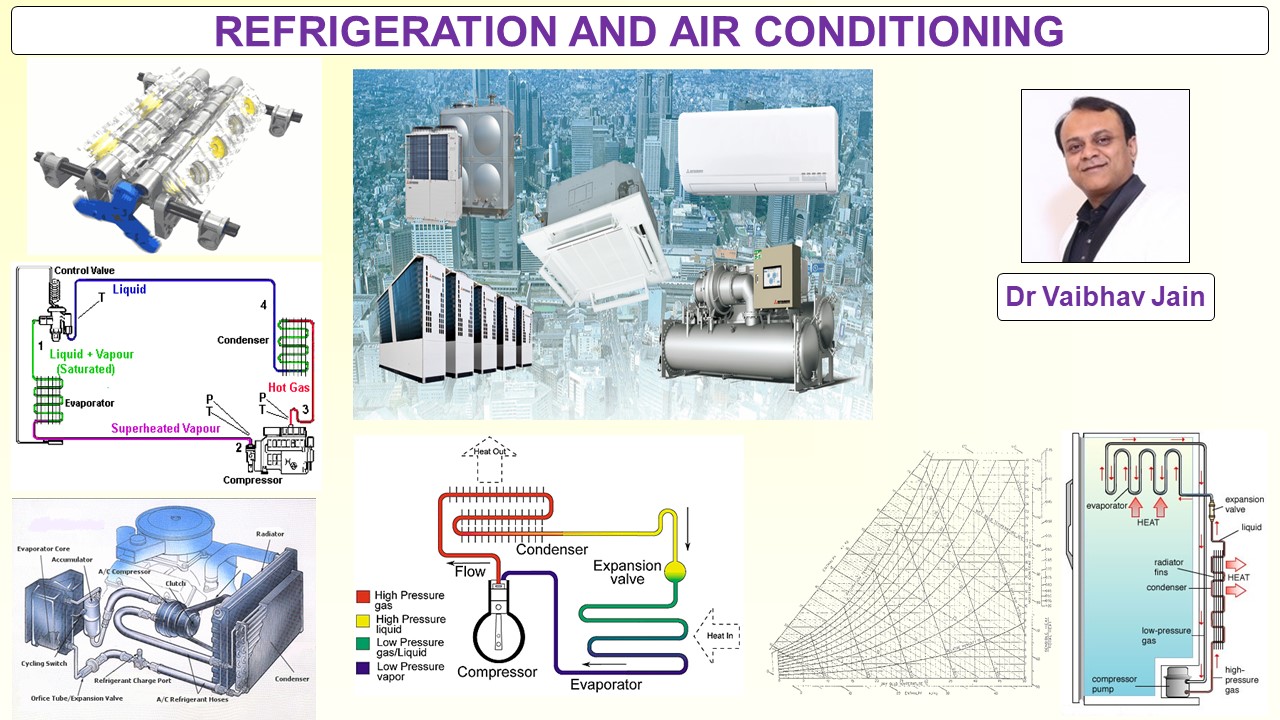
The objective of the paper is to facilitate the student with the
basics of Refrigeration & Air conditioning that are required
for an engineering student. The main objective of course are as
follows:
1. Learning the fundamental principles and different methods of refrigeration and air conditioning.
2. Study of various refrigeration cycles and evaluate performance using charts and/ or refrigerant property tables.
3. Comparative study of different refrigerants with respect to properties, applications and environmental issues.
4. Study of the various equipment-operating principles, operating and safety controls employed in refrigeration air conditioning systems.
5. Understand the basic air conditioning processes on psychometric charts, calculate cooling load for its applications in comfort and industrial air conditioning.
1. Learning the fundamental principles and different methods of refrigeration and air conditioning.
2. Study of various refrigeration cycles and evaluate performance using charts and/ or refrigerant property tables.
3. Comparative study of different refrigerants with respect to properties, applications and environmental issues.
4. Study of the various equipment-operating principles, operating and safety controls employed in refrigeration air conditioning systems.
5. Understand the basic air conditioning processes on psychometric charts, calculate cooling load for its applications in comfort and industrial air conditioning.
- Teacher: Vaibhav Jain
Course Objectives :
1. To describe the functions, roles and skills of managers and illustrate how the manager’s job is evolving.
2. To evaluate approaches to goal setting, planning and organizing in a variety of circumstances.
3. To evaluate contemporary approaches for staffing and leading in an organization
4. To analyze contemporary issues in controlling for measuring organizational performance.
1. To describe the functions, roles and skills of managers and illustrate how the manager’s job is evolving.
2. To evaluate approaches to goal setting, planning and organizing in a variety of circumstances.
3. To evaluate contemporary approaches for staffing and leading in an organization
4. To analyze contemporary issues in controlling for measuring organizational performance.
- Teacher: Anil Kumar Dahaiya
- Teacher: Piu Jain
Engineering Graphics is a foundational course aimed at developing the ability to visualize and represent objects in two and three dimensions. It introduces the basics of technical drawing, projection methods, and the use of drawing instruments, essential for all engineering disciplines. The course emphasizes accuracy, clarity, and compliance with BIS (Bureau of Indian Standards) drawing practices.
- Teacher: Surbhi Upadhyay
- Teacher: Harsh Joshi
The students in this course are required to analyse reasons for failure of different components and select the required materials for different applications. For this purpose, it is essential to teach them concepts, principles, applications and practices covering stress, strain, bending moment, shearing force, shafts, columns and springs. Hence this subject has been introduced. It is expected that efforts will be made to provide appropriate learning experiences in the use of basic principles to the solution of applied problems to develop the required competencies.
Training Module on Stainless Steel Focuses on Mechanical Properties and Metallurgy of Stainless Steel
- Teacher: Anil Gupta
- Teacher: Vipin Kumar Sharma
This course is designed to introduce the Foundational Web Technologies for Mechanical Engineering Students. The course is divided into four modules: (1) HTML (2) CSS (3) JS (4) MySQL. Classes are conducted offline in the Computer Lab of the Department. Each student is provided with a personal account on the database server to practice SQL commands and manage their own databases throughout the course.
- Teacher: Ved Nath Mathur
Offline/Online classes can be arranged for interested students.
Contact Dr. V.N.Mathur / Dr. Deshdeep Gambhir
- Teacher: Deshdeep Gambhir
- Teacher: Ved Nath Mathur